
The Cripple
Roland is journeying along a 'dusty thoroughfare', which is nonetheless 'safe'. He encounters an old cripple and, by inference, 'ask[s him] the road'. Though the text is ambiguous, it is possible that Roland also lies to him, giving a false answer when asked whither he wishes to get to. Roland claims, we can guess, to be on the same worldwide quest that he has been on for years, but in reality he now no longer either expects or hopes to achieve his goal. When the cripple answers and indicates that to continue his quest he must leave the road that he is currently on, Roland seems to take it for granted that the cripple is lying, and that he has detected Roland's own lie. This is because the way the cripple points is 'Into that ominous tract which, all agree, / Hides the Dark Tower.' Roland knows that by leaving the road he will not achieve his original quest and will be counted a failure. (Implicitly, when he gets to the Dark Tower either he will die or be taken prisoner and remain there for the rest of his days.) And so, presuming that the cripple knows that this is where his true heart lies, Roland pretends to believe him, and does turn in the direction he indicated, feeling sure at the same time that the cripple is now laughing at him behind his back and gloating over his fate. Roland judges that the cripple's purpose in being there (whether his own or some other's) is to misdirect travellers in their quests.
| MY first thought was, he lied in every word, | |
| That hoary cripple, with malicious eye | |
| Askance to watch the working of his lie | |
| On mine, and mouth scarce able to afford | |
| Suppression of the glee, that purs’d and scor’d | 5 |
| Its edge, at one more victim gain’d thereby. | |
| What else should he be set for, with his staff? | |
| What, save to waylay with his lies, ensnare | |
| All travellers who might find him posted there, | |
| And ask the road? I guess’d what skull-like laugh | 10 |
| Would break, what crutch ’gin write my epitaph | |
| For pastime in the dusty thoroughfare, | |
| If at his counsel I should turn aside | |
| Into that ominous tract which, all agree, | |
| Hides the Dark Tower. Yet acquiescingly | 15 |
| I did turn as he pointed: neither pride | |
| Nor hope rekindling at the end descried, | |
| So much as gladness that some end might be. | |
For, what with my whole world-wide wandering, | |
| What with my search drawn out thro’ years, my hope | 20 |
| Dwindled into a ghost not fit to cope | |
| With that obstreperous joy success would bring,— | |
| I hardly tried now to rebuke the spring | |
| My heart made, finding failure in its scope. | |
As when a sick man very near to death | 25 |
| Seems dead indeed, and feels begin and end | |
| The tears and takes the farewell of each friend, | |
| And hears one bid the other go, draw breath | |
| Freelier outside, (“since all is o’er,” he saith, | |
| “And the blow fallen no grieving can amend;”) | 30 |
| While some discuss if near the other graves | |
| Be room enough for this, and when a day | |
| Suits best for carrying the corpse away, | |
| With care about the banners, scarves and staves, | |
| And still the man hears all, and only craves | 35 |
| He may not shame such tender love and stay. | |
| Thus, I had so long suffer’d, in this quest, | |
| Heard failure prophesied so oft, been writ | |
| So many times among “The Band”—to wit, | |
| The knights who to the Dark Tower’s search address’d | 40 |
| Their steps—that just to fail as they, seem’d best. | |
| And all the doubt was now—should I be fit? | |
So, quiet as despair, I turn’d from him, | |
| That hateful cripple, out of his highway | |
| Into the path he pointed. |
The Grey Plain
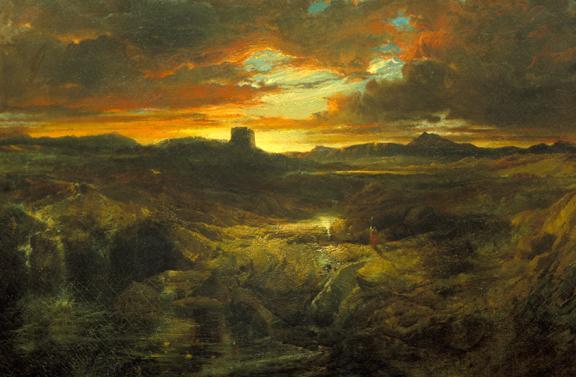
As he abandons the safe road though, Roland turns to find it (and the cripple?) have disappeared. He is trapped in a pathless 'grey plain'. It is not clear in which direction Roland is headed, and whether he turned back to look towards the setting sun or away from it. (Is he travelling eastwards or westwards? In Thomas Moran's famous painting it would appear that the Dark Tower lies in the west.)
| All the day | 45 |
| Had been a dreary one at best, and dim | |
| Was settling to its close, yet shot one grim | |
| Red leer to see the plain catch its estray. | |
For mark! no sooner was I fairly found | |
| Pledged to the plain, after a pace or two, | 50 |
| Than, pausing to throw backward a last view | |
| O’er the safe road, ’t was gone; gray plain all round: | |
| Nothing but plain to the horizon’s bound. | |
| I might go on; nought else remain’d to do. | |
So, on I went. I think I never saw | 55 |
| Such starv’d ignoble nature; nothing throve: | |
| For flowers—as well expect a cedar grove! | |
| But cockle, spurge, according to their law | |
| Might propagate their kind, with none to awe, | |
| You ’d think; a burr had been a treasure trove. | 60 |
| No! penury, inertness and grimace, | |
| In the strange sort, were the land’s portion. “See | |
| Or shut your eyes,” said Nature peevishly, | |
| “It nothing skills: I cannot help my case: | |
| ’T is the Last Judgment’s fire must cure this place, | 65 |
| Calcine its clods and set my prisoners free.” | |
| If there push’d any ragged thistle=stalk | |
| Above its mates, the head was chopp’d; the bents | |
| Were jealous else. What made those holes and rents | |
| In the dock’s harsh swarth leaves, bruis’d as to baulk | 70 |
| All hope of greenness? ’T is a brute must walk | |
| Pashing their life out, with a brute’s intents. | |
As for the grass, it grew as scant as hair | |
| In leprosy; thin dry blades prick’d the mud | |
| Which underneath look’d kneaded up with blood. | 75 |
The Horse
Just as the sunset failed to inspire any sense of beauty, and just as the cripple inspired antipathy, so a blind lame horse inspires hatred.
| One stiff blind horse, his every bone a-stare, | |
| Stood stupefied, however he came there: | |
| Thrust out past service from the devil’s stud! | |
Alive? he might be dead for aught I know, | |
| With that red, gaunt and collop’d neck a-strain, | 80 |
| And shut eyes underneath the rusty mane; | |
| Seldom went such grotesqueness with such woe; | |
| I never saw a brute I hated so; | |
| He must be wicked to deserve such pain. |
Cuthbert and Giles
Roland recalls Cuthbert and Giles, the one disgraced, the other hanged for treason. (Were they other failures?)
| I shut my eyes and turn’d them on my heart. | 85 |
| As a man calls for wine before he fights, | |
| I ask’d one draught of earlier, happier sights, | |
| Ere fitly I could hope to play my part. | |
| Think first, fight afterwards—the soldier’s art: | |
| One taste of the old time sets all to rights. | 90 |
| Not it! I fancied Cuthbert’s reddening face | |
| Beneath its garniture of curly gold, | |
| Dear fellow, till I almost felt him fold | |
| An arm in mine to fix me to the place, | |
| That way he us’d. Alas, one night’s disgrace! | 95 |
| Out went my heart’s new fire and left it cold. | |
| Giles then, the soul of honor—there he stands | |
| Frank as ten years ago when knighted first. | |
| What honest man should dare (he said) he durst. | |
| Good—but the scene shifts—faugh! what hangman hands | 100 |
| Pin to his breast a parchment? His own bands | |
| Read it. Poor traitor, spit upon and curst! | |
Better this present than a past like that; | |
| Back therefore to my darkening path again! |
The River
Roland crosses a 'sudden little river'.
A Muddy Area
He imagines that a battle must have been fought there.
The Harrow
A furlong on he finds an "engine", "wheel", "brake" (not wheel) or "harrow"
The Stubbed Ground
It was once a wood next to a marsh.
The Palsied Oak
It has a cleft in it.
The Blackbird
Apart from the Cripple and the Horse, this is the only other living thing Roland encounters.
The Mountains... and the Dark Tower
Roland suddenly finds himself in a mountainous area, with a mountain on his left, two hills on his right, and in between the tower itself.
New Dawn and a New Sunset
Roland crosses a 'sudden little river'.
| No sound, no sight as far as eye could strain. | 105 |
| Will the night send a howlet of a bat? | |
| I asked: when something on the dismal flat | |
| Came to arrest my thoughts and change their train. | |
A sudden little river cross’d my path | |
| As unexpected as a serpent comes. | 110 |
| No sluggish tide congenial to the glooms; | |
| This, as it froth’d by, might have been a bath | |
| For the fiend’s glowing hoof—to see the wrath | |
| Of its black eddy bespate with flakes and spumes. | |
So petty yet so spiteful All along, | 115 |
| Low scrubby alders kneel’d down over it; | |
| Drench’d willows flung them headlong in a fit | |
| Of mute despair, a suicidal throng: | |
| The river which had done them all the wrong, | |
| Whate’er that was, roll’d by, deterr’d no whit. | 120 |
| Which, while I forded,—good saints, how I fear’d | |
| To set my foot upon a dead man’s cheek, | |
| Each step, or feel the spear I thrust to seek | |
| For hollows, tangled in his hair or beard! | |
| —It may have been a water-rat I spear’d, | 125 |
| But, ugh! it sounded like a baby’s shriek. | |
| Glad was I when I reach’d the other bank. |
A Muddy Area
He imagines that a battle must have been fought there.
| Now for a better country. Vain presage! | |
| Who were the strugglers, what war did they wage | |
| Whose savage trample thus could pad the dank | 130 |
| Soil to a plash? Toads in a poison’d tank, | |
| Or wild cats in a red-hot iron cage— | |
The fight must so have seem’d in that fell cirque. | |
| What penn’d them there, with all the plain to choose? | |
| No foot-print leading to that horrid mews, | 135 |
| None out of it. Mad brewage set to work | |
| Their brains, no doubt, like galley-slaves the Turk | |
| Pits for his pastime, Christians against Jews. |
The Harrow
A furlong on he finds an "engine", "wheel", "brake" (not wheel) or "harrow"
| And more than that—a furlong on—why, there! | |
| What bad use was that engine for, that wheel, | 140 |
| Or brake, not wheel—that harrow fit to reel | |
| Men’s bodies out like silk? with all the air | |
| Of Tophet’s tool, on earth left unaware, | |
| Or brought to sharpen its rusty teeth of steel. |
The Stubbed Ground
It was once a wood next to a marsh.
| Then came a bit of stubb’d ground, once a wood, | 145 |
| Next a marsh, it would seem, and now mere earth | |
| Desperate and done with; (so a fool finds mirth, | |
| Makes a thing and then mars it, till his mood | |
| Changes and off he goes!) within a rood— | |
| Bog, clay, and rubble, sand and stark black dearth. | 150 |
| Now blotches rankling, color’d gay and grim, | |
| Now patches where some leanness of the soil’s | |
| Broke into moss or substances like thus; |
The Palsied Oak
It has a cleft in it.
| Then came some palsied oak, a cleft in him | |
| Like a distorted mouth that splits its rim | 155 |
| Gaping at death, and dies while it recoils. |
The Blackbird
Apart from the Cripple and the Horse, this is the only other living thing Roland encounters.
| And just as far as ever from the end, | |
| Nought in the distance but the evening, nought | |
| To point my footstep further! At the thought, | |
| A great black bird, Apollyon’s bosom-friend, | 160 |
| Sail’d past, nor beat his wide wing dragon-penn’d | |
| That brush’d my cap—perchance the guide I sought. |
The Mountains... and the Dark Tower
Roland suddenly finds himself in a mountainous area, with a mountain on his left, two hills on his right, and in between the tower itself.
| For, looking up, aware I somehow grew, | |
| Spite of the dusk, the plain had given place | |
| All round to mountains—with such name to grace | 165 |
| Mere ugly heights and heaps now stolen in view. | |
| How thus they had surpris’d me,—solve it, you! | |
| How to get from them was no clearer case. | |
Yet half I seem’d to recognize some trick | |
| Of mischief happen’d to me, God knows when— | 170 |
| In a bad perhaps. Here ended, then, | |
| Progress this way. When, in the very nick | |
| Of giving up, one time more, came a click | |
| As when a trap shuts—you ’re inside the den. | |
Burningly it came on me all at once, | 175 |
| This was the place! those two hills on the right, | |
| Couch’d like two bulls lock’d horn in horn in fight, | |
| While, to the left, a tall scalp’d mountain … Dunce, | |
| Dotard, a-dozing at the very nonce, | |
| After a life spent training for the sight! | 180 |
| What in the midst lay but the Tower itself? | |
| The round squat turret, blind as the fool’s heart, | |
| Built of brown stone, without a counter-part | |
| In the whole world. The tempest’s mocking elf | |
| Points to the shipman thus the unseen shelf | 185 |
| He strikes on, only when the timbers start. |
New Dawn and a New Sunset
| Not see? because of night perhaps?—Why, day | |
| Came back again for that! before it left, | |
| The dying sunset kindled through a cleft: | |
| The hills, like giants at a hunting, lay, | 190 |
| Chin upon hand, to see the game at bay,— | |
| “Now stab and end the creature—to the heft!” |
The Other Knights of the Band
It is possible, though it is not made clear either implicitly or implicitly by the text, that Roland enters the tower and climbs to its summit, before looking out again. The other knights who have ended up at the Dark Tower - or, by inference, their ghosts, since Roland's own life is now, by implication, almost over - appear in the hills. He hears their names in his ears, getting louder and louder 'like a bell', and as the sun sets again he sees them 'in a sheet of flame'.
| Not hear? when noise was everywhere! it toll’d | |
| Increasing like a bell. Names in my ears | |
| Of all the lost adventurers my peers,— | 195 |
| How such a one was strong, and such was bold, | |
| And such was fortunate, yet each of old | |
| Lost, lost! one moment knell’d the woe of years. | |
There they stood, ranged along the hill-sides, met | |
| To view the last of me, a living frame | 200 |
| For one more picture! in a sheet of flame | |
| I saw them and I knew them all. |
The Slughorn
Unbroken and unbowed, Roland winds a horn, announcing that though he has failed in his quest he has at least reached its end.
| And yet | |
| Dauntless the slug-horn to my lips I set, | |
| And blew “Childe Roland to the Dark Tower came.” |

No comments:
Post a Comment